Chapter 39. Shortcut for flux: the divergence theorem
§39.1 [TEXT] The divergence theorem
Remember back when we had Green’s theorem, we could transform 2D scalar flux (which was a line integral) into an area integral:
This was nice because parametrization was annoying and straight-up area integrals are simpler. In general, if you still have the poster, the green pictures are easier to deal with.
The divergence theorem will let you do the same thing, transforming a flux surface integral (which is the horrendous surface integral that has been haunting you for the last couple weeks) into a volume integral. Which is an even bigger profit — no parametrization, no cross product table, etc.
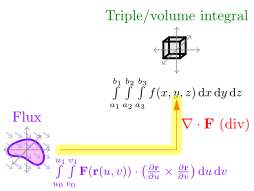
Here’s the result:
Suppose a closed surface encloses a compact solid , and is defined everywhere in . Then
I’ve snuck in a new symbol , but the extra circle is analogous to before. Just like how was a reminder that was a closed loop:
Also, note there’s a fine-print requirement that should be compact, i.e. it should not extend infinitely in any direction.
If you’re unclear what “closed surface” means, a picture to keep in your head might be “holds water”, i.e., you could imagine filling the interior of with a water (that’s the volume ) and it shouldn’t leak out. So the following are not closed surfaces:
- Curved part of hemisphere (e.g., bowl with no lid)
- Curved part of cylinder (e.g., straw)
But the following are closed surfaces:
- Cylinder including the two caps (e.g., water bottle)
- Sphere
- The six faces of a rectangular prism
We can jump straight into examples now!
Solution. The sphere encloses a ball of radius . The divergence is given by
Then the answer is
This was also the first example we did with the surface area trick, where we found that the answer was which is also .
Actually, put another way: if you know the volume of the sphere is and the divergence theorem, then the surface area trick lets you derive the surface area formula of .
You need to be careful to only apply the divergence theorem if the force is actually defined on the entire solid ! Here’s an example of what can go wrong.
Let denote the sphere of radius again. Let be the force of gravity exerted by a point mass at the origin. In the last chapter we computed
using the surface area trick.
However, if you compute the divergence , you’ll actually find it’s zero at every point — except the origin, where is undefined because the gravity causes division-by-zero. (See Exercise 32.1.) If you blindly apply the divergence theorem and don’t notice the issue with the origin, you would instead get the wrong answer , rather than the correct answer . (That said, see Exercise 39.2 for a safe usage.)
Solution. The divergence is
Hence the flux turns into
Due to the symmetry of the cube:
If you can’t see it by symmetry, you could also just explicitly calculate
In any case, we get an answer of
Solution. The surface is hard to describe, but it encloses some solid . However, if you compute the divergence, it is
So it doesn’t even matter what the solid is; the answer is just
Solution. Let denote the region enclosed by . The divergence is given by
The region is bounded by and , within . So the divergence theorem means we need to calculate
Naturally, this is best done using cylindrical coordinates. Writing and , and remembering that
then this becomes
But the integrals with in them are going to be zero by symmetry. For example, the first term is
Similarly, the contribution of is just zero as well. So we are just left with
Obviously . The double integral can be evaluated as
Hence the final answer is
§39.2 [SIDENOTE] A picture for why the divergence theorem is true
The picture is actually exactly the same as Figure 90 from Section 35.4, our picture of Green’s theorem for 2D flux! The divergence is still drawn as green explosions. The only change is in the dimensions:
- For Green’s theorem for flux, we have a 1D path (purple square) enclosing a 2D region broken up into little grey squares.
- For divergence theorem, we have a 2D surface (purple box) enclosing a 3D regions broken up into little grey cubes.
And the rest of the analogy carries over: all the interior green arrows cancel except for those pushing directly against the purple faces of the cube, so there’s the flux integral we wanted.
§39.3 [RECAP] All the methods for flux
Here’s a complete recipe for flux, augmented with the two shortcuts we described.
Suppose we need to calculate the flux of through a surface .
If is a closed region, use the divergence theorem to avoid parametrization:
If happens to equal the same constant everywhere (as described in Section 38.6), then output times the surface area of , i.e.
Otherwise, fall back to the parametrization recipe described in Section 38.5. To describe it again here briefly:
- Get the cross product by either looking it up from Table 23 or by computing it by hand, for a parametrization of the surface .
- If necessary, negate the cross product to match the orientation of the surface specified in the question.
- Compute the dot product .
- Integrate over the region using any method for double integrals.
§39.4 [TEXT] Advanced technique: sealing regions
This is the 3D analog of Section 34.6: in some situations if you have a surface which isn’t closed, you can seal it by adding some part to the surface. The picture you can have in your head is that you have a bowl or something, and then you add a layer of plastic wrap on the bowl.
Let be the vector field defined by:
Consider the hemisphere defined by the equation:
oriented outward. Compute the flux of through .
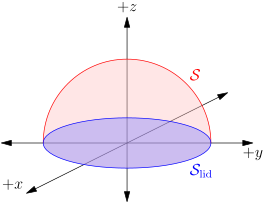
Solution. Our picture is that looks like an upside-down bowl. So we add a lid consisting of the disk and . This encloses a solid region , half a solid ball of radius , as in Figure 95.
The divergence of is:
which is constant. So the integral of the divergence over is just
Meanwhile, (which we orient downwards) is a flat surface, so its flux integral is easy to calculate: from Table 23 we choose and hence
So when we apply the divergence theorem, we get that
Hence, we get the answer
§39.5 [EXER] Exercises
Exercise 39.2. Suppose and are two closed surfaces that don’t intersect and such that is contained inside . Orient both surfaces outwards. Let be a point contained inside . Consider the force of gravity exerted by a point mass of mass at . Show that
Exercise 39.3 (*). Prove Green’s theorem for flux by quoting the divergence theorem.
That is, suppose is a vector field in and is a closed loop enclosing a region counterclockwise. Find a way to use the divergence theorem to prove