Chapter 44. Solutions to Part Charlie
§44.1 Solution to Exercise 10.1 ()
Exercise 10.1 (*). Without a calculator, give an example of an ordered pair of integers satisfying
The idea is to consider the complex number
Hence one possible choice is
§44.2 Solution to Exercise 10.2 ()
Exercise 10.2. Calculate
The answer is . The point is that each of the arctangents is an acute angle in , and the sum of the angles will match the argument of the complex number
That is, the complex arguments of , , are , , and respectively, and the argument will hence be the sum of those three acute angles.
However, we can compute by direct multiplication:
Because this number is pure imaginary its argument is as needed.
§44.3 Solution to Exercise 11.1 (projection onto plane)
Answer: .
First approach using vector projection
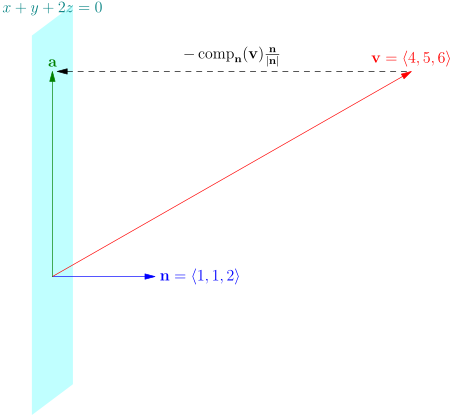
Previously you had to calculate the distance from a vector to a plane. This problem only requires one step on top of that: you need to then translate by that multiple of the normal vector. See Figure 98, where denotes the answer. To execute the calculation, let and . The scalar component is
The vector projection is then
Then the desired projection is
Second approach using normal vectors only (no projection stuff)
A lot of you don’t find vector projection natural (I certainly don’t). So it might be easier to imagine shifting by some multiple of and then work out which multiple it is.
Specifically, we’re looking for26 a real number such that the vector
lies on the plane . But we can actually solve for just by plugging this into the equation of the plane:
Hence the answer
§44.4 Solution to Exercise 11.2 (geometric interpretation)
Exercise 11.2 (*). Suppose , , , are points in . Give a geometric interpretation for this expression:
Answer: The quantity
equals the volume of the tetrahedron .
In general, the volume of the tetrahedron is the volume of the parallelepiped formed by , , . So we will prove that
gives the volume of that parallelepiped. Here are two approaches for proving it.
First approach using coordinates
Let , , , . Then expanding the cross product gives
If you think about what evaluating the determinant using the formula together with the dot product would give, you should find it’s actually just
which is the volume of the parallelepiped.
Second approach using geometric picture
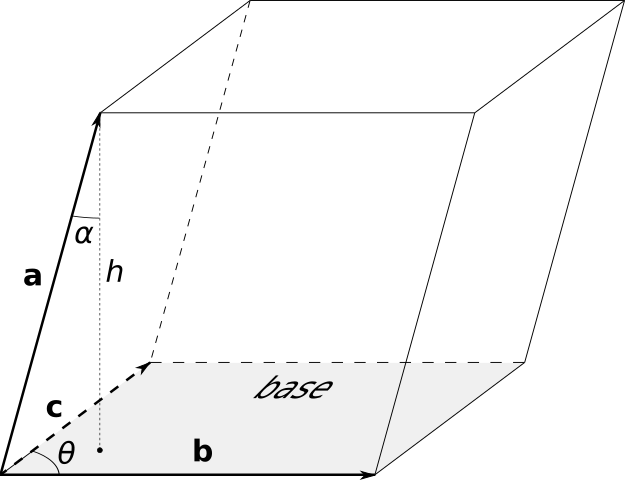
The cross product is a vector whose area is equal to the parallelogram formed by and . The dot product of that cross product against is equal to the height of to plane times this area, and the volume is the height times the area. See the following picture from https://en.wikipedia.org/wiki/Triple_product (in the Wikipedia figure, denotes our , etc.).
§44.5 Solution to Exercise 11.3 (determinant of projection)
Answer: 0, no matter which plane is picked.
First approach using basis vectors
Let , , be the three basis vectors. Then:
- The matrix is formed by gluing , , together.
- I claim the vectors , , are linearly dependent. After all, they are all contained in the two-dimensional plane by definition, and so three vectors in a plane can’t be linearly independent.
- So the determinant is equal to zero (this theorem is one of the criteria we use to check whether vectors are linearly independent or not).
Second approach using eigenvectors
Let be any nonzero normal vector to . Then , so is an eigenvector with eigenvalue . Since the determinant is the product of the eigenvalues, the determinant must be too.
Third approach using coordinate change
This approach requires you to know the fact that the determinant doesn’t change if you rewrite the matrices in a new basis.
Let be any nonzero normal vector to . Pick two more unit vectors and perpendicular to that span . Then , and are linearly independent and spanning, i.e. a basis of . So we can change coordinates to use these instead.
We know that
If we wrote as a matrix in this new basis (rather than the usual basis), we would get the matrix
which has determinant .
§44.6 Solution to Exercise 11.4 (perpendicular unit vectors)
Answer: and .
Since is contained in the span of and , we can just pay attention to the plane spanned by these two perpendicular unit vectors. So the geometric picture is that can be drawn in a rectangle with and as a basis, as shown. Because and , this rectangle is by .
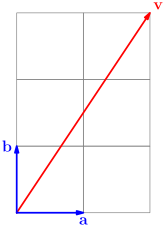
Now the magnitude of the cross product is supposed to be equal to the area of the parallelogram formed by and , which is (because this parallelogram has base and height ). Similarly, has magnitude .
§44.7 Solution to Exercise 11.5 (trace of matrix)
Exercise 11.5. Compute the trace of the matrix given the two equations
Answer: .
There are several approaches possible. The first two show how to find the four entries of the matrix . The latter sidestep this entirely and show that the matrix is actually always trace .
First approach: brute force
Like in the pop quiz in my R04 notes, we will try to work out and . We’re looking for constants and such that .
Solving the system of equations and using your favorite method gives coefficients and , i.e.
This lets us get
By solving the analogous system we can find the identity
and hence:
Gluing these together
The trace is thus .
Second approach: inverse matrices
We can collate the two given equations into saying that
Hence one could also recover by multiplying by the inverse matrix:
(Of course, we get the same entries for as the last approach.) Again the trace is .
Third approach: Guessing eigenvectors and eigenvalues
Let and . Adding and subtracting the given equations gives
So are eigenvectors with eigenvalues . Since is a matrix there are at most two eigenvalues: we found them all!
The trace of is the sum of the eigenvalues. Call in the answer .
Fourth approach: Change coordinates
This approach requires you to know the fact that the trace doesn’t change if you rewrite the matrices in a new basis.
Since and are a basis of , we can change coordinates to use the . In that case,
If we wrote as a matrix in this new basis (rather than the usual basis), we would get the matrix
which has trace .
§44.8 Solution to Exercise 11.6 (complex triangle)
Answer: .
We start by converting the complex number into polar form. The modulus of is:
The argument is some random angle we won’t use the exact value of: .
Now to find the cube roots of , we use the polar form:
for . This gives us three roots corresponding to the different values of .
This looks like an equilateral triangle centered around the origin, where each spoke coming from the origin has magnitude , where
See Figure 101.
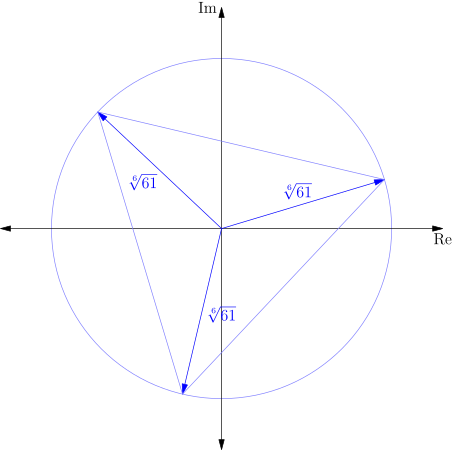
If we cut up the equilateral triangle by the three arrows above, we get three small isosceles triangles with a angle at the apex. The area of each triangle is going to be .
So this gives a final answer of