Chapter 3. Review of vectors
§3.1 [TEXT] Notation for scalars, vectors, points
If you haven’t seen the symbol before, let’s introduce it now:
The symbol “”, if you haven’t seen it before, means “is a member of”. So is the statement “ is a real number”. Or means that is a real number.
Unfortunately, right off the bat I have to mention that the notation could mean two things:
By we could mean one of two things, depending on context:
- The vectors of length , e.g. the vector is a vector in .
- The points in -dimensional space, e.g. is a point in .
To work around the awkwardness of meaning two possible things, this book will adopt the following conventions for variable names:
Bold lowercase letters like and will be used for vectors. When we draw pictures of vectors, we always draw them as arrows.
Capital letters like and are used for points. When we draw pictures of points, we always draw them as dots.
Sometimes, if we need to refer to the vector drawn as an arrow which starts at point and ends at , we write for it.
We’ll also use different notation for actual elements:
- A vector will either be written in column format like , or with angle brackets as if the column format is too tall to fit.
- But a point will always be written with parentheses like .
Some vectors in are special enough to get their own shorthand. (The notation “” means “is defined as”.)
When working in , we define
When working in , we define
In other places, you’ll sometimes see , , instead, but this book will always use .
§3.2 [TEXT] Length
The length of a vector is denoted by and corresponds to the length of the arrow drawn. It is given by the Pythagorean theorem.
In two dimensions:
In three dimensions:
In dimensions, if , the length is .
§3.3 [TEXT] Directions and unit vectors
Remember that a vector always has
- both a magnitude, which is how long the arrow is in the picture, and
- a direction, which refers to which way the arrow points.
In other words, the geometric picture of a vector always carries two pieces of information. (Here, I’m imagining we’ve drawn the vector as an arrow with one endpoint at the origin and pointing some way.)
In a lot of geometry situations we only care about the direction, and we want to ignore the magnitude. When that happens, one convention is to just set the magnitude equal to :
Thus we use the concept of unit vector to capture direction. So in , is thought of as “due east” and is “due west”, while is “due north” and is “northeast”.
Given any vector in besides the zero vector, the direction along is the unit vector
which is the unit vector that points the same way that does.
(Depending on what book you’re following, more pedantic authors might write “the unit vector in the direction of ” or even “the unit vector in the same direction as ” rather than “direction along ”. This is too long to type, so I adopted the shorter phrasing. I think everyone will know what you mean.)
We will avoid referring to the direction of the zero-vector , which doesn’t make sense. (If you try to apply the formula here, you get division by , since is the only vector with length .) If you need it, the convention is that it has every direction.
Let’s first do examples in so we can draw some pictures.
The direction along the vectors , or are all , thought of as due east.
But the direction along the vectors or are both , thought of as due west.
The direction along the vectors , are all , thought of as due south.
How about the direction along ? We need to first find the length of the vector so we can scale it down. That’s given by the Pythagorean theorem, of course:
So the direction along would be
See Figure 1. The direction is somewhere between south and southeast.
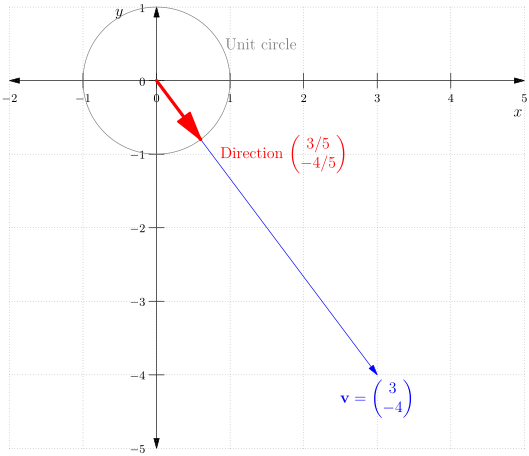
When drawn like Figure 1 in the two-dimensional picture , the notion of direction along is almost like the notion of slope in high school algebra (so the slope of the blue ray in Figure 1). But there are a few reasons our notion of direction is more versatile than just using the slope of the blue ray.
- The notion of direction can tell the difference between , which goes southeast, and , which goes northwest. Slope cannot; it would assign both of these “slope ”.
- The due-north and due-south directions and would have undefined slope due to division-by-zero, so you always have to worry about this extra edge case. With unit vectors, due-north and due-south don’t cause extra headache.
- Our definition of direction works in higher dimension . There isn’t a good analog of slope there; a single number cannot usefully capture a notion of direction in for .
The direction along the three-dimensional vector is
See if you can figure out where the came from.
§3.4 [RECIPE] Areas and volumes
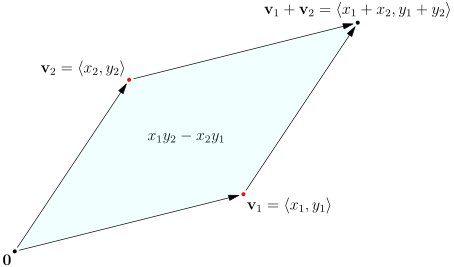
If and are vectors, drawn as arrows with a common starting point, then , , and their sum make a parallelogram in the plane together with , as shown in Figure 2.
The following theorem is true, but we won’t be able to prove it in 18.02.
The signed area of the parallelogram formed by and is equal to
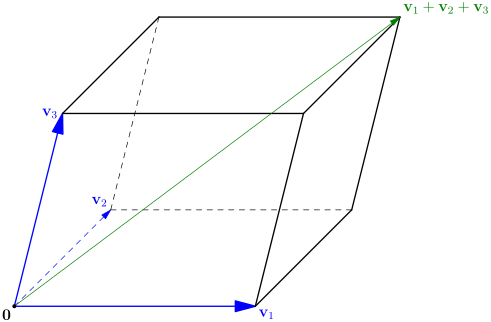
A similar theorem is true for the parallelepiped9 with three vectors in ; see Figure 3.
The signed volume of the parallelepiped formed by , , is equal to
You might have noticed that the word “signed” has slipped in before “area” and “volume”. What does that mean? Well, if you only care about the area of the volume itself, it doesn’t matter for you; you should just take the absolute value of the determinant. But the sign carries a bit more information.
In 2D, consider the angle between and , between and . Then we consider the sign to be if the angle goes counterclockwise from to , (like the example in Figure 2), and negative otherwise. So in Figure 2, we would have
In 3D, the convention follows the right-hand rule: suppose vectors , , are given in that order. Curl the fingers of your right hand from to ; then the signed volume is positive if your thumb points in the direction of (as in Figure 3, for example) and negative otherwise.
If you’re interested in the proof of these results and their -dimensional generalizations, the tool needed is the wedge product, which is denoted
This is well beyond the scope of 18.02, but it’s documented in Chapter 12 of my Napkin for those of you that want to read about it.
Alternatively, I think Wikipedia and Axler10, among others, use a definition of the determinant as the unique multilinear alternating map on -tuples of column vectors in that equals for the identity. This definition will work, and will let you derive the formula for determinant, and gives you a reason to believe it should match your concept of area and volume. It’s probably also easier to understand than wedge products. However, in the long term I think wedge products are more versatile, even though they take much longer to setup.
§3.5 [EXER] Exercises
Exercise 3.1. Compute the unit vector along the direction of the vector