Chapter 42. Solutions to Part Alfa
§42.1 Solution to Exercise 2.1 (type safety)
Exercise 2.1. Let , , be vectors in . By using Table 1 (or skimming Section 4.1 briefly), determine whether each of the following expressions is a real number, a vector, or nonsense (type-error); there should be one of each.
- (here order of operations is before )
(The symbol confusingly can refer to three different things: grade-school multiplication, scalar multiplication, or the dot product.)
The expression is a vector, since
The expression is a type-error since
The expression is a real number since
§42.2 Solution to Exercise 3.1 (direction)
Exercise 3.1. Compute the unit vector along the direction of the vector
The point of this example is to emphasize that you can scale out weird positive constants like ; the vector
points in the same direction. So it’s enough to find the unit vector in the direction of which is
(Note that is not a correct answer: that vector points in the opposite direction.)
§42.3 Solution to Exercise 3.2 ()
I claim the answer is
Here are two ways to see this:
- To see it geometrically, consider the parallelepiped formed by the column vectors of . If we scale each of its side lengths by , then the volume should increase by a factor of .
To see it algebraically, in the formula for the determinant the point is that every term scales up by a factor of , and the products are three at a time.
This might be easier to see from an example, so let’s take
as an example of a matrix with determinant :
Then
so
§42.4 Solution to Exercise 3.3 (coplanar)
Call the points , , , .
There are several approaches to this (including ones that use later material); the one using the material in this chapter is the following:
Choose as the reference point. Then, the vectors from to the other points are:
Then construct a matrix using these vectors as columns:
The determinant of is:
Compute each minor determinant:
Substituting back:
Hence .
§42.5 Solution to Exercise 4.1 (4d vectors)
We need the dot product to be zero:
§42.6 Solution to Exercise 4.2 (projection)
Exercise 4.2.
- Compute the vector projection of in the direction of .
- Compute the scalar component and vector projection of along the direction of .
The first part asks to compute the vector projection of in the direction of . The answer is just
You could get this using the recipe if you wanted, but if you draw a picture the point is you’re just projecting the vector to the -axis, which gives you its -component.
For the second part, let
Note that the factor of in doesn’t matter, since scaling doesn’t matter. We’ll keep the around just for illustration reasons, but in practice an experienced student would just use instead.
We just follow the recipe in Section 4.4 directly. We first compute the dot product:
The magnitude is
The scalar component of along is given by:
The vector projection of along is given by:
§42.7 Solution to Exercise 4.3 (dot product )
Geometrically, we expect there to be two solutions: if is the angle between the two vectors, we need , and so there should be two vectors that work. See Figure 96 for a picture. (You might already guess one of the solutions — obviously works — but we’ll pretend we didn’t notice that.)
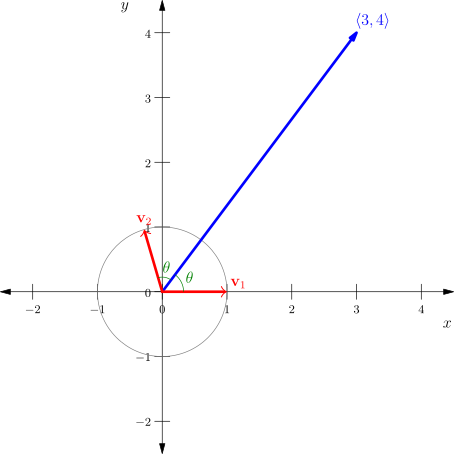
Translating the givens algebraically, we have the following system of equations:
From the dot product condition, solve for :
Substitute into and solve:
Hence either or .
- If we get . Thus, the first unit vector is: .
- If we get . Thus, the second unit vector is: .
In conclusion the answer is
See Figure 96 for a picture of the two answers.
§42.8 Solution to Exercise 4.4 ( and )
Construct vectors and in . Then the problem statement is saying that , , and asks for all possible values of . But the geometric definition of the dot product says that
where is the angle between and .
Since could be any angle at all (as and are arbitrary vectors), the possible values of will range over the interval as ranges from to .
§42.9 Solution to Exercise 5.1 (faces of a cube)
The main observation is this:
And the normal vectors to the two planes are:
For the planes to be perpendicular, their normal vectors must satisfy:
Solving for gives .
§42.10 Solution to Exercise 5.2 (distance to two planes)
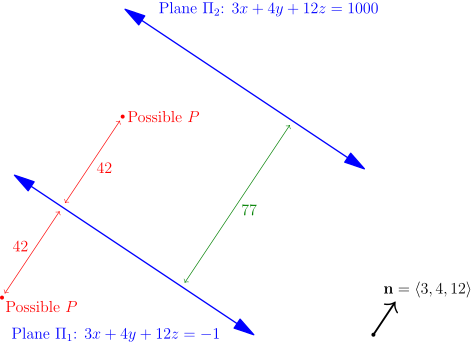
Denote the planes
See Figure 97. Let be the desired distance.
The idea is that the planes are parallel, so there really should just be two possible answers. To do the algebra, first observe that (parallel) planes and have the same normal vector:
which has .
Now to compute the distance between and , we consider an arbitrary point on (meaning ) and find the distance from it to . According to the recipe in Section 5.6, it equals
Hence the answers are , that is or .
If you don’t have the idea of looking at the distance between and , you can still solve the problem by applying the recipe in Section 5.6 directly to . Indeed, suppose . Then
The first equation tells us that
The second equation tells us that
and this gives the same answers.
§42.11 Solution to Exercise 6.1 (cross product )
Exercise 6.1. Suppose real numbers and satisfy
Compute and .
Two nonzero vectors have cross product if and only if they’re multiples of each other. Hence we get and .
§42.12 Solution to Exercise 6.2 ()
Using properties of the cross product:
The fact that follows either directly from the geometric definition (the parallelogram has times the area) or from looking at the algebraic definition (where the and factor out). Whereas the fact that also follows directly from the right-hand rule.
§42.13 Solution to Exercise 6.3 ()
Exercise 6.3. Let and be unit vectors in . Compute all possible values of
Let be the angle between the vectors. Then the geometric definitions of the cross and dot products give
Hence the answer is
by the Pythagorean theorem: there is only one possible value.
§42.14 Solution to Exercise 6.4 (solving for )
Exercise 6.4. Suppose is a vector in and is a real number such that
Compute .
The point is that and are supposed to be perpendicular; the vector is otherwise completely irrelevant. For them to be perpendicular we need
.