Chapter 46. Solutions to Part Echo
§46.1 Solution to Exercise 13.1 (five level curve drawings)
Exercise 13.1. Draw 2D level curves for some values for the following functions:
- (i.e. outputs the larger of its two inputs, so and , for example).
In what follows, always denotes the value we’re drawing the level curve for.
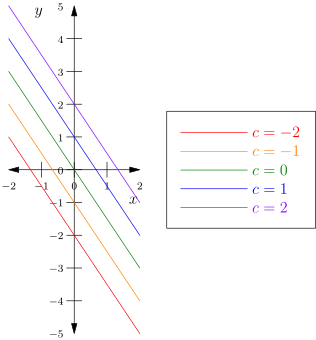
- For
The level curves of will be straight lines with slope whose -intercept is the point . See Figure 102.
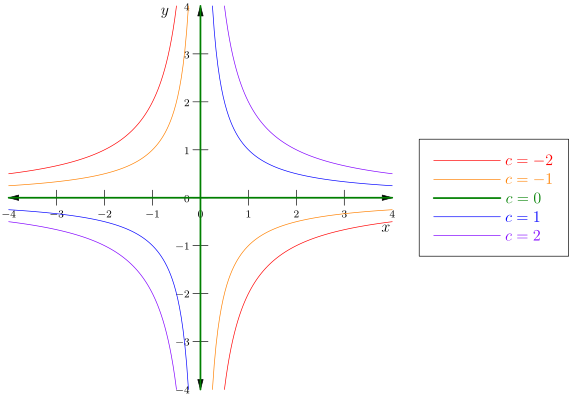
- For
When , the shape of is a hyperbola . For the exceptional value , the shape is the union of the axes. See Figure 103.
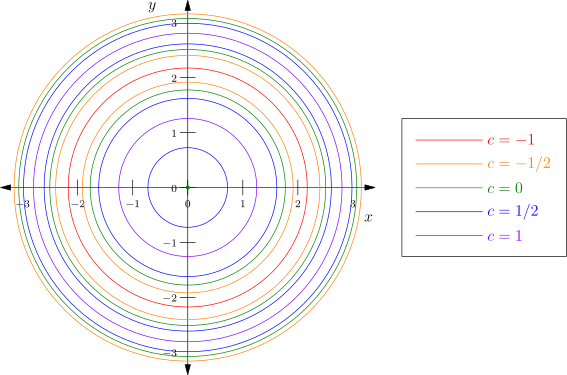
- For
The level curve is only nonempty when . For these , we obtain a bunch of concentric circles whose radii satisfy . For example, when , we get circles of radius , , , and so on. See Figure 104.
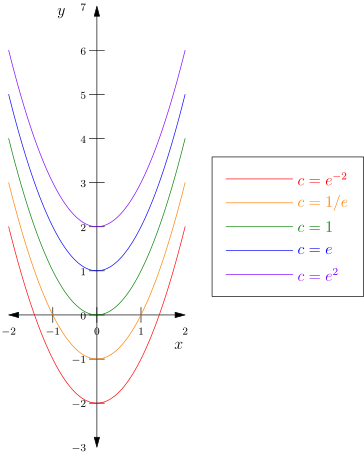
- For
The level curve is only nonempty when . The level curve is the parabola . See Figure 105.
- For
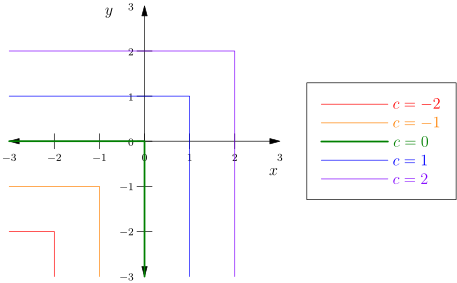
The curve consists of what look like rotated L-shapes, as shown in the figure. See Figure 106.
§46.2 Solution to Exercise 13.2 (level curve with seven points)
This is quite tricky. The following function should work:
Then if and only if the product of the seven quadratics we gave was zero, i.e. we have for some . But that can only happen when .
In other words, this level curve for consists of only seven points: , , , , , , and .
§46.3 Solution to Exercise 14.1 (partial derivative practice)
Exercise 14.1. Compute all the partial derivatives of the following functions, defined for :
- .
This is direct calculation and doesn’t require any trick.
For we compute :
For the same reason:
For we compute :
For the same reason:
For we compute :
For the same reason:
§46.4 Solution to Exercise 15.1 (tangent to sphere)
The equation of the given sphere is:
To find the equation of the tangent plane at the point , we first compute the gradient of the function
The gradient is:
Evaluating at :
Hence the tangent plane should be given by
for some number . In order for this to pass through , we take
Hence the answer is
Or one could write this as if you don’t like the unneeded factor of .
§46.5 Solution to Exercise 15.2 (given level curve is a circle)
Exercise 15.2. The level curve of a certain differentiable function for the value turns out to be a circle of radius centered at .
- Give an example of one such function .
- What are all possible vectors that could be?
- Do linear approximation to estimate starting from the point .
Examples of functions
For an example, one natural choice for is:
This satisfies:
which defines a circle of radius centered at the origin. There are other examples, such as
or
and so on.
Possible gradients
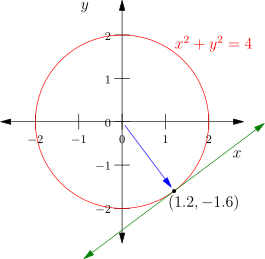
For the second part, let denote the point . Then lies on this circle. However, from high school geometry (no calculus involved), the tangent to the circle at is the line . (See Figure 107.) The gradient needs to be some perpendicular to this line, so it must be some vector in the direction of . That is, could be27 any multiple of .
Linear approximation
For the linear approximation step, we have
But the vectors and are perpendicular. So the dot product vanishes, and the answer is .
§46.6 Solution to Exercise 15.3 (preview of anti-gradients)
Exercise 15.3. For each part, either give an example of or show that none exist.
- Can you find a function such that ?
- Can you find a function such that ?
- Can you find a function such that ?
- Can you find a function such that ?
For the first three exercises, one just takes the following:
The fourth task is impossible: no such function could exist. One will see this more clearly in later chapters, but even directly now, one might be able to realize that from one should have
and there’s no way one can differentiate that with respect to and get just . Again, read Chapter 16 for more details.
§46.7 Solution to Exercise 15.4 (level curve through )
Exercise 15.4 (*). Let , , , be nonzero real numbers and let
Suppose the level curve of for the value is tangent to the line at the origin, and also passes through . Compute .
The gradient of is given by
At the origin we get
The condition that the level curve is tangent to the line at the origin means the gradient vector must be a multiple of the normal vector to , which is . In other words, we should have
We also know that . We compute
As , we conclude
and so .
§46.8 Solution to Exercise 16.1 (anti-gradient practice)
Exercise 16.1. Suppose is a differentiable function and that
for some constants and . Compute the constants and , and determine .
We are given the gradient of a function :
To compute and , we compute
These need to be equal for all so we require .
To recover , we write
Stitching these together to get the final expression for as:
for any constant .