Chapter 10. Complex numbers
§10.1 [TEXT] It’s a miracle that multiplication in has geometric meaning
Let denote the set of complex numbers (just as denotes the real numbers). It’s important to realize that, until we add in complex multiplication, is just an elaborate cosplay.
| Concept | For | For |
|---|---|---|
| Notation | ||
| Components | ||
| Length | Length | Abs val |
| Direction | (slope, maybe?) | argument |
| Length | unit vector | |
| Multiply | NONE | ✨ ✨ |
At the start of the course, I warned you about type safety, and I repeatedly stressed to you that you cannot multiply two vectors in to get another vector. (You had a “dot product”, but it spits out a number. Honestly, you shouldn’t think of dot product as a “product”; the name sucks.)
Of course, the classic newbie mistake (which you better not make on your midterm) is to define a product on vectors component-wise: why can’t and have “product” ? Well, in 18.02, every vector definition needed a corresponding geometric picture for us to consider it worthy of attention. This definition has no geometric meaning.
However, there is a big miracle for . For complex numbers, you can define multiplication by
and there is an amazing geometric interpretation.
Unfortunately, AFAIK there is no English word for “complex number whose absolute value is one”, the same way there is for “unit vector”. For 18.02, we instead use
as the “word”; whenever you see , draw it as unit vector .
But for 18.02, when starting out, I would actually think of the notation as a mnemonic, i.e. a way to remember the following result:
(6)
This is in my opinion the biggest miracle in all of precalculus. Really, I want to stress: Equation 6 is supposed to be astonishing. My goal by the end of this chapter is to convince you that something really powerful is happening in Equation 6 allowing you to do things that you absolutely should not expect to be able to do.
More generally, the result you need to know is:
Suppose and are complex numbers. To describe :
The magnitude of is the product of the magnitudes of and . That is,
(7)
- The argument of is the sum of the arguments of and . This is Equation 6.
Here’s a simple example.
Let’s consider the complex numbers:
Following your high school, the product is calculated as follows:
The above theorem is promising that if we use polar form, the angles will add and the magnitudes will multiply. Let’s verify this holds up.
For the magnitudes, you can do this by hand: we have and , and indeed we have the miraculous
The angles here probably need a calculator to verify. For the angles, from and , we have
so we’re expecting that
and indeed , as needed!
Here’s a more substantial example, which shows how Equation 6 can be used to compute things that wouldn’t be feasible by hand with the rectangular form.
Solution. The idea is that we will write in polar form as:
Then raising powers is easy, because of Equation 6. To spell it out:
We can simplify this now: we know
Compare to how annoying this would be if we tried to do it by multiplying times: the fastest way with repeated squaring would be something like
But you could easily imagine replacing with (which we’ll do shortly) or even . Such a method would quickly become infeasible; whereas the polar coordinates let us avoid all this work.
§10.2 [SIDENOTE] Extracting trig identities and the Brahmagupta-Fibonacci identity
In this optional section I want to convince you that Equation 7 and Equation 6 are doing a lot of magic. To do so I’ll show you two consequences of these equations that you would not expect to be true.
§10.2.1 Application 1: Equation 7 gives the Brahmagupta-Fibonacci identity
Let’s start with magnitudes. If you don’t trust your teacher (a good instinct to have sometimes 😉) you might not believe me that the magnitudes multiply. Because let’s say and . Then
doesn’t look related. If Equation 7 is really true, it’s promising that
In other words, the equation
(8)
is supposed to be true for all real numbers , , , .
But how could that be? Equation 8 doesn’t even look true, and if I told this to you with no context, you wouldn’t believe it. It’s not until you multiply out Equation 8 with brute force that you might believe me:
They really are equal! The has apparently cancelled out magically. (This unexpected identity is called the Brahmagupta-Fibonacci identity, if you want a name, but we won’t use this name again later.)
§10.2.2 Application 2: Equation 6 gives trig addition and double-angle formulas
Let’s say you still don’t trust your teacher (again, good!) and even though you have grudgingly admitted Equation 7 is true, you don’t believe the other equation Equation 6. Because if Equation 6 is true, then again brute-force expansion gives
So for Equation 6 to be true, you would need for any angles and that
But this is true: it’s the trig addition formula!
Put another way: if you have trouble remembering the trig addition formulas (like me), then Equation 6 shows you how you can derive it. Equation 6 is easy to remember, and if you do the expansion, the mysterious trig addition formula falls out.
The double angle formula is also a special case: from
we can read off and .
§10.3 [RECIPE] th powers of complex numbers
Earlier I showed you how to calculate rapidly using polar form. You can do this in general too: the point is that
(9)
Equation 9 is sometimes called De Moivre’s theorem, but it’s such an easy consequence of Equation 6 and Equation 7 that I don’t think it really needs its own name. Nonetheless, if you see the name in other places, it’s referring to Equation 9.
Given a complex number , to compute :
- Convert in polar form if it isn’t already.
- Use .
- Simplify the and output the answer.
Here’s the example with again, but with replaced by for emphasis.
Solution. The polar form of is:
Raising to the th power gives
Solution. First convert to polar form:
Then, when we raise to the th power, we get
The cosine and sine cycle every , so we write
We only care about the “remainder” ; we have
Substituting back:
(If you care, , so one could also write .)
§10.4 [TEXT] An example of th roots of complex numbers: solving
This section is dedicated to and is on-syllabus for exam. Specifically, you ought to be able to solve equations like . This section shows you how.
In this whole section, you always prefer to work in polar form. So if you get input in rectangular form, you should first convert to polar form. Conversely, if the answer is asked for in rectangular form, you should work with polar form anyway, and only convert to rectangular output at the end.
If you can raise to the th power, you should be able to extract th roots too, by running the recipe “backwards”. First, I will tell you what the answer looks like:
I think it’s most illustrative if I show you the five answers to
to start. Again, first we want to convert everything to polar coordinates:
At this point, we know that if , then ; all the answers should have an absolute value of . So the idea is to find the angles. Here are the five answers:
Here’s a picture of the five numbers:
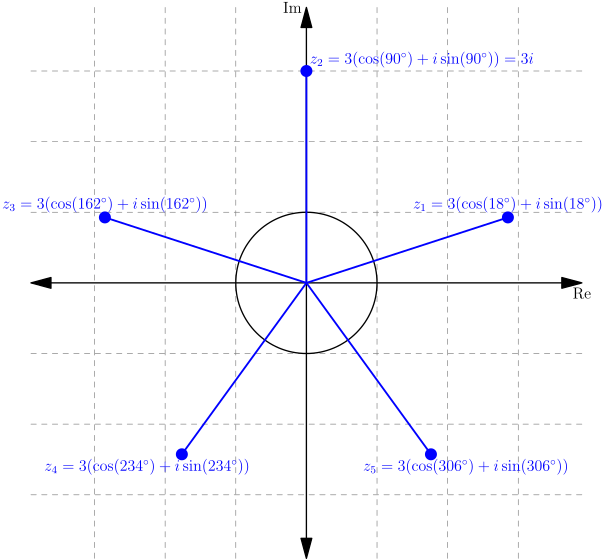
On the right column, all the numbers are equal. Notice something interesting happening on the right-hand side. The numbers and , etc. are all the same number; if you draw them in the plane, they’ll point to the same thing. However, they give five different answers on the left. But if you continue the pattern one more, you start getting a cycle
This doesn’t give you a new answer, because .
§10.5 [RECIPE] Taking the th root of a complex number
In general, if has argument , then the arguments of satisfying start at and then go up in increments of . (For example, they started at for answers to .) So you can describe the general recipe as:
- Convert to polar form; say it has angle .
- One of the answers will be .
- The other answers are obtained by increasing the angle in increments of .
Solution. We first convert to polar form as
and see that , and . The first angle is . So the five answers are
(As it happens, , which is easy to check by hand works.)
Solution. We first convert to polar form as
and see that , and . The first angle is . So the four answers are
Solution. We first convert to polar form as
and see that , and . The first angle is . So the three answers are
(As it happens, , as expected, since .)
§10.6 [RECAP] Rectangular vs polar
Every complex number can be written in either rectangular form ( for ) or polar form (). We saw that polar form (because of Equation 6 and Equation 7) is really good if you’re doing lots of multiplication. So to summarize, Table 4 tells you rules of thumb for complex numbers.
| Operation | In rectangular | In polar |
|---|---|---|
| ✅ Component-wise like in | ❌ Unless is a real multiple of | |
| ✅ Expanding | ✅ By Equation 6 + Equation 7 | |
| ✅ Write then multiply | ✅ By Equation 6 + Equation 7 | |
| ❌ Possible but takes forever | ✅ Shown in Section 10.3 | |
| th root of | ❌ Not recommended for | ✅ Shown in Section 10.5 |
§10.7 [EXER] Exercises
Exercise 10.1 (*). Without a calculator, give an example of an ordered pair of integers satisfying
Exercise 10.2. Calculate