Chapter 6. The cross product
The cross product is the last major linear algebra tool we’ll need to introduce (together with determinants and the dot product). Like the dot product, the cross product also has two definitions, one algebraic and one geometric.
However, unlike the dot product, the cross product is more stilted and unnatural, and not used as much — in fact it won’t show up again until Chapter 29. (More on that in Section 6.4.) I’ll try to keep this chapter brief.
§6.1 [TEXT] The two definitions of the cross product
This definition is terrible, so bear with me.
Suppose and are two vectors in .
The algebraic definition of the cross product is:
(2)
(See the tip below for a way to remember this formula more easily.)
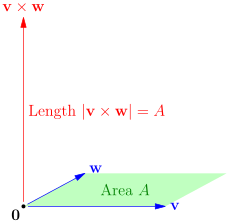
The geometric definition of the cross product is based on specifying both the direction and magnitude.
- The magnitude of is equal to the area of the parallelogram formed by and . In trigonometry terms, if is the included angle, this equals .
- The direction is given by requiring to be perpendicular to both and , and also satisfying the right-hand rule (we’ll say more about it in a moment).
The geometric definition is illustrated in Figure 13 below.
Like with the dot product, it’s not obvious at all why these definitions are compatible! Equation 2 is probably also really mysterious and seems to come from nowhere. In this case, I think the idea is that you should start with the geometric definition, then grind through some calculation to get a system of equations. If you solve the system of equations, you wind up with Equation 2 as the result. We do this in the next section as an optional sidenote.
The hack with the right-hand rule is necessary because if I tell you only the length of a vector in and that it is normal to two other vectors in , there are actually two vectors that work. (For example, there are two vectors of length perpendicular to and : namely .)
So we need to pick one, and the right-hand rule says that if you point your right index finger along and right middle finger along closer to your palm, and stick out your right thumb, then points along your thumb.
Another way to describe the right-hand rule is to require the following table to be true:
It may not be that easy to remember Equation 2. In practice, I think almost everyone uses the following mnemonic for it.
The algebraic definition is usually remembered using the following mnemonic:
(3)
Mathematically speaking, the right-hand side doesn’t make sense and is a type-error, because one can’t have a matrix where some things in it are numbers and other things in it are vectors. However, if you ignore that and multiply anyway, you’ll get the algebraic definition above.
In these notes I will always use Equation 3 rather than Equation 2 because that’s what people actually do in practice. (I do so quite grudgingly, because Equation 3 is officially a type-error, and in theory it is nonsense. But in the words of Linus Torvalds: “Theory and practice sometimes clash. And when that happens, theory loses. Every single time.”)
From either definition, you should be able to see that
in contrast to the dot product. Note the minus sign. (The right hand rule means that you can’t swap your index and middle finger.)
Also, note that (or indeed whenever and are parallel).
I really want to get this section over with so I’ll just give you one example with numbers and not even talk about the corresponding geometry.
Solution. Write
As a sanity check for the geometry definition, you can verify that indeed this vector is perpendicular to both and using the dot product:
§6.2 [SIDENOTE] Outline of derivation of the cross product formula
In this sidenote, we outline how the algebraic definition of the cross product can be derived from the geometric one. This proof is too hard to be on an 18.02 exam, but I decided to include it here instead of the appendix because it is actually good practice with using dot products and determinants. For simplicity, I won’t worry at all about division-by-zero issues.
So let’s say we have two given vectors
Let’s denote the cross product by
We need to solve for , , in terms of , , , , , .
So what are the givens? Well, first we have the requirement that should be perpendicular to and . So we get two equations from the dot product:
This is a system of two equations in three variables, but it’s good enough to get the ratio . For example, if you multiply the first equation by and the second by , then subtract, you will get that
In a similar way, you can get the ratio as
Geometrically, this means we’ve already recovered the direction of . Algebraically, it means we know the ratio ; there should be some scalar constant such that
So all we need to do now is find . For brevity, we’ll let
so , , , and we need to solve for .
We have one more condition to use, which is that we want the magnitude to be equal to the area of the parallelogram spanned by and , and also point in the way specified by the right-hand rule. How can we encode that in an equation? At face value, none of the weapons in our toolkit so far let you access the area of a parallelogram in 3D space. We only have a determinant for parallelograms in 2D space.
But here’s a clever trick to get around it. The trick to get the area is to consider the parallelepiped formed by three vectors: the two given vectors and and the unit vector in the direction of . That is, consider the vector
We’ve just seen is perpendicular to both and , and we’ve scaled so that . See Figure 14.
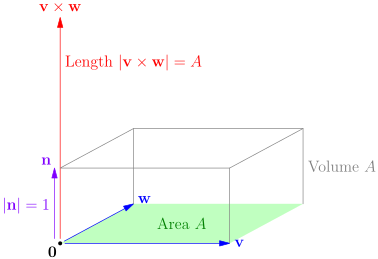
For simplicity let’s assume that points the correct way for the right-hand rule. (If points the other way, the calculation below will need a bunch of extra minus signs; we won’t dwell on it here, again to keep things simple.) So if we consider the parallelepiped formed by , , , its volume will just be the height times the base parallelogram, i.e. it is . And the volume of a parallelepiped is something we can access: it’s a determinant. So our trick has managed to let us get our hands on :
Here, the determinant is indeed (rather than ) because was assumed to be pointing the correct direction, so the determinant yields a plus sign. This trick of introducing is what lets us get a formula for which would otherwise be inaccessible with only the determinant at face value.
Now we solve for . Because we’re in the case that is pointing the right way, we know we should have . Now we have to set the magnitude of
equal to above; that is, we get the equation
Multiplying both sides by and expanding the determinant gives
If you now look at the definition of , , , you will see that the determinants on the right-hand side are conveniently equal to , , and , respectively. So suddenly the whole thing cancels and we just get . So , , and this gives the algebraic formula we wanted.
§6.3 [RECIPE] What to use the cross product for
Unlike the dot product, which is just a number, the cross product is a vector. So it has more information in it — both a direction and a magnitude.
- The direction of is perpendicular to both and .
- The magnitude is the area of the parallelogram.
However in practice, when we use the cross product, we’ll often only use one piece of information. (It’s not until Chapter 38 that we really start using both parts at once.)
Hence the following two recipes below.
To find a vector perpendicular to both and at once:
- Output any nonzero multiple of .
To find the area of the parallelogram formed by and in :
- Output the magnitude of .
Notice in the first recipe, we ignore the magnitude; in the second recipe, we ignore the direction.
Consider the three points , , .
- Find a normal vector to the plane through , , .
- Compute the equation of the plane.
- Compute the area of triangle .
Solution. First, let’s find a normal vector to the plane through , , and . The idea is to compute two vectors and :
These two vectors can be drawn as arrows contained in the plane through them. So if we compute the cross product, we’ll get a normal vector we wanted! That is,
That’s the normal vector. To find the equation of the plane, we know that we should have
for some constant . Plugging in any of the three points , , gives (the redundancy here gives us a way to check our arithmetic, too). So the plane is
Finally, the area of is half the area of the parallelogram formed by and , so that
§6.4 [SIDENOTE] The cross product sucks
Compared to dot products and determinants, the cross product might feel the most unnatural, for good reason — it’s used much less frequently by serious mathematicians than the other tools you see. See Figure 15.
The reason that the cross product isn’t popular with mathematicians is the definition of the cross product is really quite brittle. For example, the cross product can’t be defined for any number of dimensions,11 and you have to remember this weird right-hand rule that adds one more arbitrary convention. So the definition is pretty unsatisfying.
To replace the cross product, mathematicians use a different kind of object called a bivector, an element of a space called . (They might even claim that bivectors do everything cross products can do, but better.) Again, this new kind of object is well beyond the scope of 18.02 but it’s documented in Chapter 12 of my Napkin if you do want to see it.
I’ll give you a bit of a teaser though. In general, for any , bivectors in are specified by coordinates. So for you could translate every bivector in into a vector in by just reading the coordinates (although you end up with the right-hand rule as an artifact of the translation), and the cross product is exactly what you get. But for , a bivector in has six numbers, which is too much information to store in a vector in . Similarly, for , this translation can’t be done. That’s why the cross product is so brittle and can’t work past .
§6.5 [RECAP] Recap of vector stuff up to here
A brief summary of the last few chapters.
The dot and cross products have algebraic formulas and geometric properties that make them useful in a lot of 3D geometry applications.
The dot product lets you detect perpendicularity and projections.
- Two vectors are perpendicular if and only if their dot product is zero.
The cross products generates perpendicularities and lets you compute area.
Both are used in the theory of planes:
- We use the dot product to show that the normal vector to the plane is the vector .
- We use the projection from the dot product to find the distance from a point to a plane.
- Given three points on a plane, the cross product lets us find the normal vector.
See also Table 2, which summarizes some of the vectors we’ve seen in applications.
| Vector | Direction | Magnitude |
|---|---|---|
| Normal vector to plane | Perpendicular to plane | Irrelevant! |
| Same as | Scalar component | |
| Cross product | Perpendicular to both and | Area of parallelogram |
§6.6 [EXER] Exercises
Exercise 6.1. Suppose real numbers and satisfy
Compute and .
Exercise 6.3. Let and be unit vectors in . Compute all possible values of
Exercise 6.4. Suppose is a vector in and is a real number such that
Compute .