Chapter 5. Planes and their normal vectors
In general, the equation of a plane in takes the shape
where , , , are real numbers (and , , are not all zero).
§5.1 [TEXT] Normal vectors to planes in
In 18.01, we had lines in , and we used the notion of slope of the line often. For 18.02, planes don’t have a “slope”; not a single number, anyway. So the thing I want to communicate is:
So what’s that? A normal vector to a plane is a vector such that, if you pick any point on the plane, then the arrow joining to — that is, the arrow when you draw the starting point as — is perpendicular to that plane.
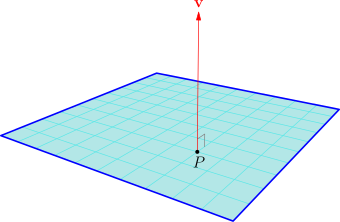
(Note that it doesn’t matter which point you pick. You could equally well even ignore altogether, imagine drawing as an arrow starting from some random point not necessarily on the plane — like the origin — and requiring that punctures the plane at a right angle.)
The main goal of this chapter is to prove the following result:
Keep in mind that normal vectors only matter up to scaling: if is a normal vector, then so are , , etc.
§5.2 [TEXT] Normal vectors to lines in
Before explaining why this is true in , I want to do everything in first for comparison, where pictures are easier to draw and you have intuition from eighth or ninth grade algebra.
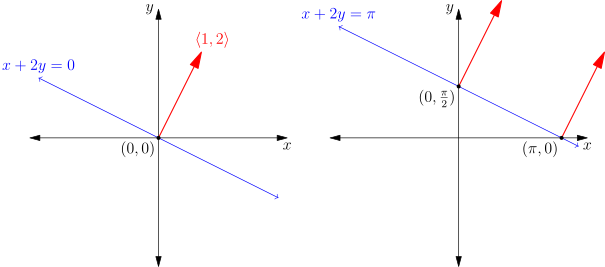
Here’s a question: which vectors in are perpendicular to ? They’re the vectors lying on a line of slope through the origin, namely
See Figure 9.
Okay, in that case what does the line
look like? Well, it’s a parallel line, the slope is still the same.
Equivalently, you could also imagine it as the vectors such that
or do the same thing for any point on the line, like
or even
But that’s silly. Most of the time you don’t care about base points. All you care is the line has slope , and for that the LHS just needs to be (or even ). The RHS can be whatever you want.
§5.3 [TEXT] Normal vectors to a plane
In , the exact same thing is true for the expression . The only difference is that the word “slope” is banned. Nevertheless, even if we can’t talk about slope, we can still talk about parallel planes, and now the whole discussion carries over wholesale.
For example, what’s the set of vectors perpendicular to ? That’s the same as requiring
So the plane passes through the origin and has normal vector .
What about something like ? Analogous to last section different ways to write it are:
Rewriting the equation as , the plane can be thought of as the points such that
Rewriting the equation as , the plane can be thought of as the points such that
Rewriting the equation as , the plane can be thought of as the points such that
Rewriting the equation as , the plane can be thought of as the points such that
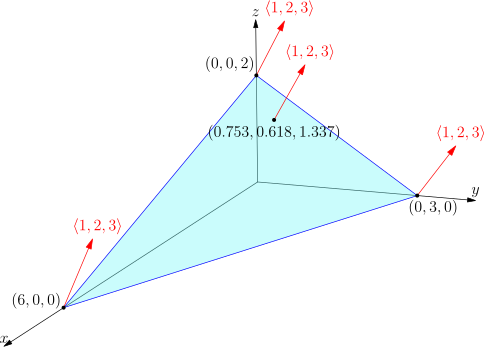
But again, like last time, the base point doesn’t really matter. The end story is the same: the coefficients control the direction of the plane via the normal vector (see Figure 10).
§5.4 [RECIPE] Finding a plane through a point with a direction
Sometimes you know the direction the plane goes, and you need to get one point to lie on it. This just means you have to pick the number to match:
Suppose the given normal vector is , and is a given point.
- Write for the left-hand side.
- Evaluate the left-hand side at to get a number .
- Output .
Solution. Planes are parallel when they have normal vectors in the same direction, so we use the normal vector for both. Hence the answer should take the form
for some . In order to pass through we should choose . So output .
§5.5 [TEXT] Calculating the distance from a point to a plane
There’s a classical exercise that’s used to test understanding of normal vectors to plane and projections, which is to find the distance from a point to a plane.
Solution. The plane has a normal vector given by the coefficients of , , and :
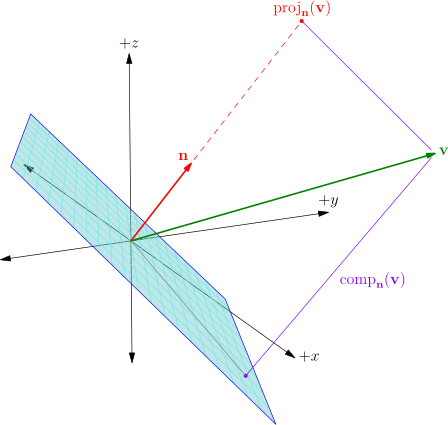
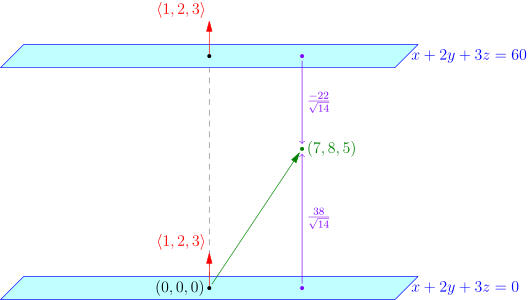
Now consider the vector pointing from the origin (which lies on the plane) to the given point . The main insight is that the scalar component of to the vector coincides with the distance we’re trying to compute; look at the figure Figure 11 to see why this is true. The point is that there’s a rectangle formed by the origin, the endpoint of , and the projections of onto and the plane, respectively.
Calculate the dot product:
Calculate the magnitude:
Hence, the scalar component is:
This is the answer.
Here’s the same exercise with one change: we change to . This means we’ll have to pick a point on the plane besides the origin.
Solution. As before, the plane has a normal vector given by the coefficients of , , and :
Now we can’t use the origin this time, but we can pick any other point on the plane; we’ll chose . (You could do the problem with or or even if you prefer; they all give the same answer.)
The vector from to is:
Now we can just repeat the steps from before, where
Hence
The distance is the absolute value .
The thing about this exercise is that you can just do it with symbols instead of numbers and get a general formula, which means that doing it with specific numbers over and over is sort of a fool’s errand. Let’s just do them all at once.
Compute the distance from a point to the plane defined by the equation
Give the answer in terms of , , , , , , .
Solution. The normal vector to the plane is given by the coefficients of , , and in the plane equation:
Now we select any base point that lies on the plane . We’ll do the case and use
but the other cases and are done in the same way. (In fact, you don’t really need to pick the base point either, it just makes the calculation a bit easier to think about in what follows.)
The vector from to is:
Now, the scalar component of along is given by
We compute it. Compute the dot product :
Compute the magnitude of :
Therefore, the scalar component is:
Finally, the distance from the point to the plane is the absolute value of the scalar component:
§5.6 [RECIPE] Distance to a plane
If you just want to memorize the final result, here it is:
If asked to find the distance from a point to the plane defined by the equation , output the answer
(We’ve moved the absolute value to the numerator, since the square root is always positive.)