Chapter 18. Regions
In 18.02, you’ll be asked to find global minimums or maximums over a constraint region , which is only a subregion of . For example, if you have a three-variable function given to you, you may be asked questions like
- What is the global maximum of (if any) across all of ?
- What is the global maximum of (if any) across the octant15 ?
- What is the global maximum of (if any) across the cube given by ?
- What is the global maximum of (if any) across the sphere ?
- … and so on.
It turns out that thinking about constraint regions is actually half the problem. In 18.01 you usually didn’t have to think much about it, because the regions you got were always intervals, and that made things easy. But in 18.02, you will need to pay much more attention.
§18.1 [TEXT] Constraint regions
To be careful about some words that are confused in English, I will use the following conventions:
- The word circle refers to a one-dimensional object with no inside, like . It has no area.
- The word open disk refers to points strictly inside a circle, like
- The word closed disk refers to a circle and all the points inside it, like or .
- The word disk refers to either an open disk or a closed disk.
Similarly, a sphere refers only to the surface, not the volume, like . Then we have open ball, closed ball, and ball defined in the analogous way.
In 18.02, all the constraint regions we encounter will be made out of some number (possibly zero) of equalities and inequalities. We provide several examples.
In :
- All of , with no further conditions.
- An open interval like in .
- A closed interval like in .
In , some two-dimensional regions:
- All of , with no further conditions.
- The first quadrant , not including the axes
- The first quadrant , including the positive and axes.
- The square and , not including the four sides of the square.
- The square and , including the four sides.
- The open disk , filled-in unit disk without its circumference.
- The closed disk , filled-in unit disk including its circumference.
In , some one-dimensional regions:
- The unit circle , which is a circle of radius , not filled.
- Both and , a quarter-arc, not including and .
- Both and , a quarter-arc, including and .
- The equation is a line.
- Both and : a line segment not containing the endpoints and .
- Both and : a line segment containing the endpoints and .
I could have generated plenty more examples for , and I haven’t even gotten to yet. That’s why the situation of constraint regions requires more thought in 18.02 than 18.01, (whereas in 18.01 there were pretty much only a few examples that happened).
In order to talk about the regions further, I have to introduce some new words. The three that you should care about for this class are the following: “boundary”, “limit cases”, and “dimension”.
The boundary is usually the points you get when you choose any one of the and constraints and turn it into an constraint. For example, the boundary of the region cut out by and (which is a square of side length ) is the four sides of the square, where either or .
The limit cases come in two forms:
- If any of the variables can go to , all those cases are usually limit cases.
- If you have any and inequalities, the cases where the variables approach those strict bounds are usually limit cases.
The dimension of is the hardest to define in words but easiest to guess. I’ll give you two ways to guess it:
Geometric guess: pick a point in that’s not on the boundary. Look at all the points of that are close to , i.e. a small neighborhood.
- Say is one-dimensional if the small neighborhood could be given a length.
- Say is two-dimensional if the small neighborhood could be given an area.
- Say is three-dimensional if the small neighborhood could be given a volume.
Algebraic guess: the dimension of a region in is usually equal to minus the number of in constraints.
Overall, trust your instinct on dimension; you’ll usually be right.
The table below summarizes how each constraint affects each of the three words above.
| Constraint | Boundary | Limit case | Dimension |
|---|---|---|---|
| or | Change to to get boundary | No effect | No effect |
| or | No effect | Approach for limit case | No effect |
| No effect | No effect | Reduces dim by one |
Let’s use some examples.
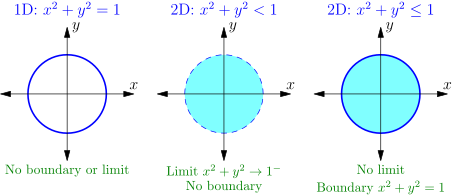
See Figure 39.
The circle is a one-dimensional shape. Again, we consider this region to be one-dimensional even though the points live in . The rule of thumb is that with variables and equality, the dimension should be .
Because there are no inequality constraints at all, and because and can’t be larger than in absolute value, there is no boundary and there are no limit cases.
The open disk is two-dimensional now, since it’s something that makes sense to assign an area. (Or the rule of thumb that with variables and equalities, the dimension should be .)
There is one family of limit cases: when approaches . But there is no boundary.
The closed disk is also two-dimensional. Because and can’t be larger than in absolute value, and there were no or constraints, there are no limit cases to consider. But there is a boundary of .
In compensation for the fact that I’m not giving you true definitions, I will instead give you a pile of examples, their dimensions, boundaries, and limit cases. See Table 9, Table 10, Table 11.
| Region | Dim. | Boundary | Limit cases |
|---|---|---|---|
| All of | 1D | No boundary | |
| 1D | No boundary | ||
| 1D | No limit cases |
| Region | Dim. | Boundary | Limit cases |
|---|---|---|---|
| All of | 2D | No boundary | or |
| 2D | No boundary | or or or | |
| 2D | or | or | |
| 2D | No boundary | ||
| 2D | or | No limit cases | |
| 2D | No boundary | ||
| 2D | No limit cases | ||
| 1D | No boundary | No limit cases | |
| 1D | No boundary | or | |
| 1D | and | No limit cases | |
| 1D | No boundary | or | |
| 1D | No boundary | or | |
| 1D | and | No limit cases |
| Region | Dim. | Boundary | Limit cases |
|---|---|---|---|
| All of | 3D | No boundary | Any var to |
| 3D | No boundary | Any var to or | |
| 3D | or or | Any var to | |
| 3D | No boundary | ||
| 3D | No limit cases | ||
| 2D | No boundary | No limit cases | |
| 2D | No boundary | or or | |
| 2D | Three quarter-circle arcs16 | No limit cases | |
| 2D | No boundary | Any var to | |
| 2D | No boundary | Any var to | |
| 2D | or or | No limit cases |
I hesitate to show these, but here are some examples where the rules of thumb fail:
An unusually cruel exam-writer might rewrite the unit circle as
instead of the more natural . Then if you were blindly following the rules of thumb, you’d get the wrong answer.
In the region cut out by the single equation
is actually -dimensional, because there’s only one point in it: .
That said, intentionally misleading constraints like this are likely off-syllabus for 18.02.
§18.2 [RECIPE] Working with regions
This is going to be an unsatisfying recipe, because it’s just the rules of thumb. But again, for 18.02, the rules of thumb should work on all the exam questions.
Given a region contained in , to guess its dimension, limit cases, and boundary:
- The dimension is probably minus the number of constraints.
- The limit cases are obtained by turning and into limits, and considering when any of the variables can go to .
- The boundary is obtained when any and becomes .
See Table 8 for a summary of these rules of thumbs, and again consult Table 9, Table 10, Table 11 for a lot of examples.